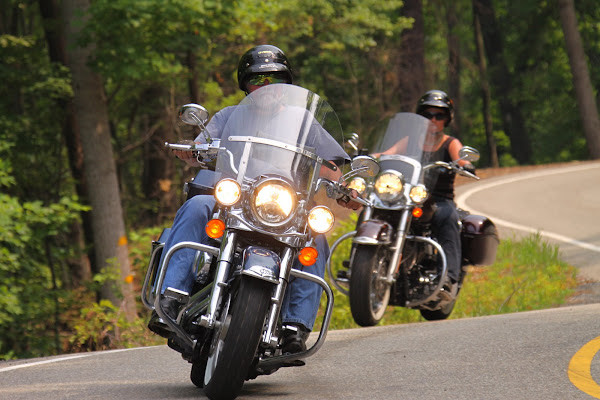
After an uneventful second night at the Microtel in Raton, New Mexico, mother nature gifted me with rain before I could even get on the road again. After drying off the Road Queen and packing up, I took a fairly direct route to my next destination of South

Fork, Colorado. I made good time and rolled into town around noon, so I decided to continue on route 160 over Wolf creek Pass at 10,550ft and down the mountain to Pagosa Springs. The last time I came over Wolf Creek Pass was in 1983 on Buffalo's Shovelhead chopper on our way to Sturgis. (yeah, I am THAT old...) At that time, route 160 was a two lane road and it had rained on us all day. This time, the weather cooperated and gave me both exhilarating views of the Rockies and also a bit of a depressing view of the valley below as I rode down the western slope. In '83, Pagosa Springs was a charming little town along the river on the way to Durango. Yesterday, I saw a HUGE RV park spreading out in the valley below. The valley has been developed with lots of cabins and the bar/restaurant that sat near the top of the highway where we had stopped that night in '83 was long gone, replaced by a Lodge, cabins and a ski resort. I spoke to Buffalo on the way up, telling him I wished he was

there with me and then, on the way down, how sad I was by what I saw. Pagosa Springs was crowded and jammed with traffic, and the afternoon was creeping up on me, so I gassed the bike up, then turned back on up the mountain towards South Fork. I realize that 43 years after our first time through, progress would clearly move things along. Colorado had become far more developed in the little town of Nederland where Buffalo and I eventually lived for a while in the 90's'. And the Peak to Peak region had grown exponentially as well. It only makes sense that other mountain areas would become more populated. It reminded me of the line, "They paved paradise and put up a parking lot."
I settled in to my room at the Quality Inn and planned my Saturday ride. I was happy to see a fantastic weather forecast the next morning when I woke up and had decided to run Colorado route 149 north towards Gunnison. I had been tracking the local fire situation and was a little concerned as some reports indicated portions might be

closed due to the path of the Elk fire. I stopped at the hotel desk where they assured me, after checking CDOT's website, that the road was clear all the way. This was a great choice, with very light, mostly local traffic. After the Road Queen fiasco the other day with gravel, I was Leary about attempting to use any of the pullouts that were all gravel to get photos... especially because of the light traffic in case I suffered a repeat! But I truly enjoyed the ride, with towering red rock spires as I headed up 149 and wide open
mountain valleys with cabins and little creeks. I had erroneously assumed the town of Creede would have a gas station. A town of about 250, most of the town was set off the highway and didn't appear to have really any services. I crossed over the Continental Divide again (I did so twice going over Wolf Cree Pass) and came into Lake City. The only incorporated city / town in Hindsdale County, this little mini city was much like what Nederland used to be in the early 90's. The popular choice of transportation there appeared to be 4x4's and they are allowed to travel freely throughout town. And there, on the highway, was not just a gas station, but a station with 91 Octane, the preference of my motorcycle! Of course, I was't at all surprised that it was nearly $6.00 a gallon, but considering it was the only gas station on route 149, that was understandable. The town itself had restaurants and nifty little shops off the highway -- all on gravel roads. I was just happy to get gas and head on to Gunnison.

In Gunnison, I stopped at the local grocery store to grab some lunch. A guy pulled in next to me in a clean, albeit aged, 1977 Chevy Blazer and we got to talking. Amazingly, he was originally from Findlay, Ohio and had lived in Elyria, Ohio for awhile as well. The day before, I had met a couple checking into the hotel that used to live in Ohio also.
From Gunnison, I caught 114 south and worked my way back to the hotel, watching the afternoon could bursts in the mountain tops around me as the afternoon heated up. Today was mild, in the low 90's, but tomorrow, when I head to Colorado Springs, the mercury is supposed to climb up over 100 again.
A couple other things of note...
The owner of the Quality Inn hotel in Steven and he is 27 years old! He started working there in housekeeping at 14 years old, worked his way into management and decided this was what he wanted to do with his future, so he bought the place!
When I was at the grocery store behind a guy with a huge amount of groceries, we chatted and it turned out he lives in Lake City and they don't have a full on grocery store there, so he comes into Gunnison once a month to stock up.
Route 149 at one time was a toll road along with toll road cut offs to Silverton.
Many things have changed in the Colorado mountains, but the small town people are still the kind of people you would want as friends and neighbors.
Peace and Love.


.jpg)
.jpg)
.jpg)
.jpg)
.jpg)
.jpg)
.jpg)
.jpg)
.jpg)
.jpg)
.jpg)
.jpg)
.jpg)
.jpg)
.jpg)
.jpg)

.jpg)
.jpg)
.jpg)


